

Introduction
Artificial Intelligence (AI) and computer vision have transformed the way machines analyze and understand images. One of the most effective image segmentation techniques used in AI is the Watershed Algorithm. This powerful method helps separate objects within an image, making it easier for AI systems to identify, classify, and analyze visual data accurately.
From medical imaging and satellite photography to industrial automation and object recognition, watershed segmentation plays a crucial role in modern computer vision applications. Understanding the meaning of watershed in AI can help developers, researchers, and technology enthusiasts appreciate its importance in image processing.
This article explores the concept of watershed segmentation, how it works, its applications, advantages, limitations, and its role in artificial intelligence.
What Does Watershed Mean in AI?
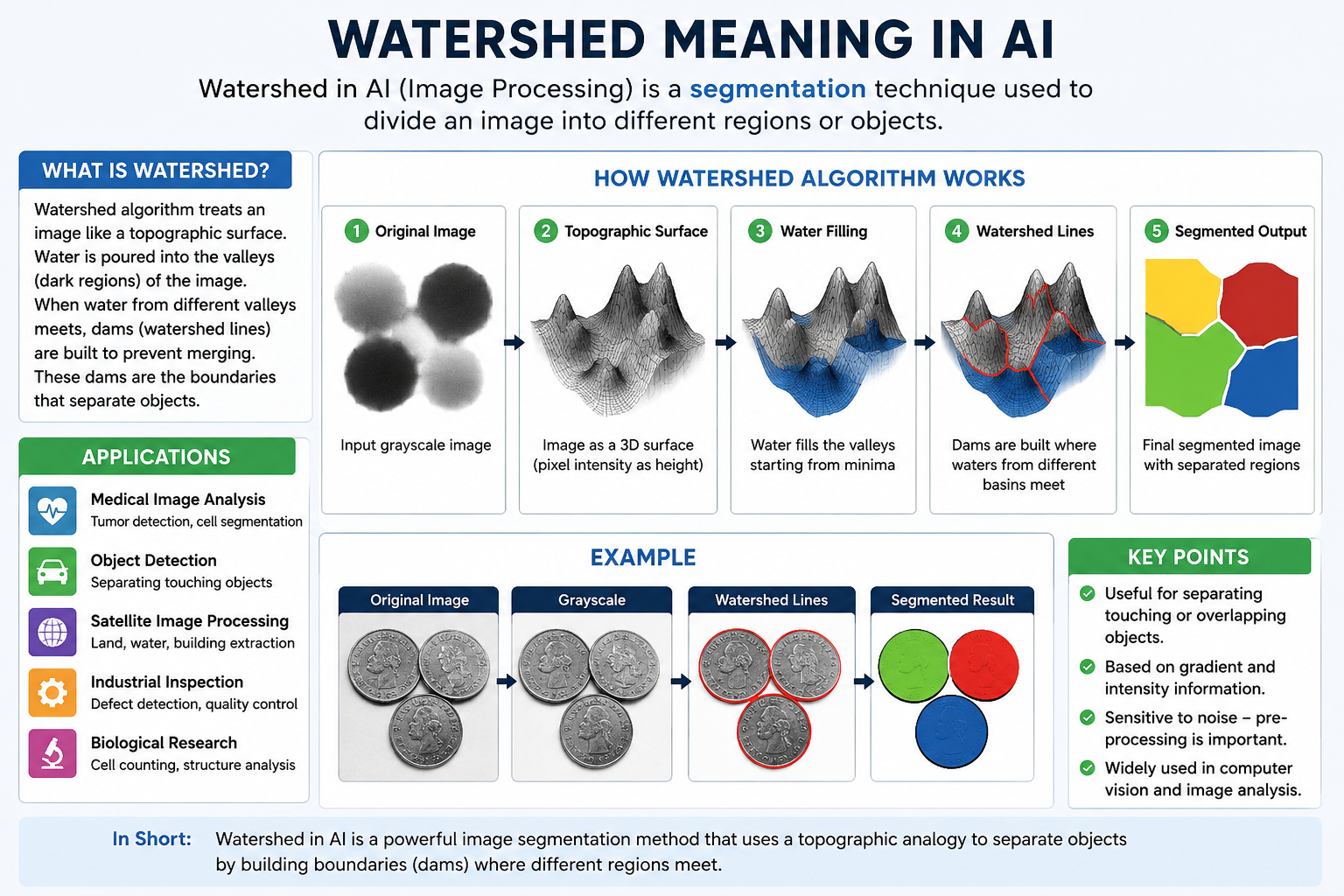
In Artificial Intelligence and image processing, a watershed is a region-based image segmentation technique used to divide an image into multiple meaningful sections or objects.
The term “watershed” comes from geography, where a watershed refers to a ridge that separates water flowing into different rivers or basins. Similarly, in image processing, the watershed algorithm identifies boundaries between different regions in an image.
The algorithm treats an image as a three-dimensional topographic surface where:
- Bright pixels represent high elevations.
- Dark pixels represent low elevations.
- Water fills low regions first.
- Boundaries form where different water basins meet.
These boundaries are used to separate distinct objects within the image.
Why Is Watershed Segmentation Important in AI?
Image segmentation is a critical component of computer vision systems. Before AI can recognize objects, it often needs to identify where one object ends and another begins.
Watershed segmentation helps AI systems:
- Detect object boundaries
- Separate overlapping objects
- Improve image recognition accuracy
- Enhance machine learning models
- Support automated decision-making
Without segmentation techniques like watershed, AI systems would struggle to accurately interpret complex visual scenes.
How the Watershed Algorithm Works
The watershed algorithm follows a process inspired by natural water flow.
Step 1: Image Representation
The image is converted into a grayscale format.
Each pixel is assigned an intensity value:
- High intensity = high elevation
- Low intensity = low elevation
This creates a virtual topographic map.
Step 2: Identifying Local Minima
The algorithm identifies the lowest points in the image.
These points serve as starting locations for water basins.
Each basin represents a potential object or image region.
Step 3: Flooding Process
The algorithm simulates water gradually filling each basin.
As water levels rise:
- Basins expand outward.
- Neighboring regions begin approaching one another.
Step 4: Creating Boundaries
When two expanding basins meet, a boundary is established.
These boundaries become segmentation lines that separate objects.
The final result is an image divided into distinct regions.
Watershed Segmentation in Computer Vision
Computer vision relies heavily on image segmentation to understand visual information.
Watershed segmentation helps:
- Object detection
- Scene understanding
- Image classification
- Pattern recognition
- Automated inspection systems
Because of its ability to identify precise boundaries, watershed remains a popular technique despite the emergence of deep learning-based segmentation methods.
Applications of Watershed in AI
1. Medical Image Analysis
One of the most important applications of watershed segmentation is medical imaging.
It helps detect:
- Tumors
- Cancer cells
- Blood vessels
- Organs
- Brain structures
Medical professionals use watershed algorithms to improve diagnosis and treatment planning.
Example
In MRI scans, watershed segmentation can separate healthy tissue from abnormal growths.
2. Object Detection
AI-powered object detection systems use segmentation to identify individual objects.
Applications include:
- Autonomous vehicles
- Security systems
- Robotics
- Smart surveillance
Watershed helps separate touching or overlapping objects that traditional methods may struggle to identify.
3. Satellite Image Processing
Satellite imagery often contains large amounts of visual data.
Watershed segmentation helps identify:
- Roads
- Rivers
- Buildings
- Agricultural fields
- Forest regions
Governments and environmental organizations use these insights for planning and monitoring purposes.
4. Industrial Automation
Manufacturing facilities use AI-powered vision systems to inspect products.
Watershed segmentation assists with:
- Defect detection
- Quality control
- Shape analysis
- Component identification
This improves efficiency while reducing human error.
5. Biological Research
Scientists use watershed algorithms to analyze microscopic images.
Applications include:
- Cell counting
- Bacteria analysis
- Tissue segmentation
- DNA research
The algorithm is particularly useful when cells overlap or touch each other.
Advantages of Watershed Segmentation
Watershed segmentation offers several benefits that make it valuable in AI applications.
Accurate Boundary Detection
The algorithm provides highly detailed object boundaries.
This improves object recognition performance.
Effective for Touching Objects
Many segmentation methods struggle when objects overlap.
Watershed excels at separating:
- Cells
- Coins
- Mechanical parts
- Biological structures
Simple Concept
Despite its powerful capabilities, the underlying concept is relatively easy to understand and implement.
Widely Supported
Most image processing libraries include watershed functions.
Examples include:
- OpenCV
- MATLAB
- Scikit-image
- ImageJ
Strong Performance
When properly configured, watershed segmentation delivers highly accurate results across many applications.
Limitations of Watershed Segmentation
While effective, watershed algorithms also have limitations.
Over-Segmentation
One common issue is over-segmentation.
Small image variations may create many unnecessary regions.
This can result in excessive boundaries.
Sensitivity to Noise
Noisy images can produce inaccurate segmentation.
Preprocessing techniques are often required.
Examples include:
- Image smoothing
- Noise reduction
- Filtering
Computational Complexity
Large images may require significant processing power.
Performance optimization is often necessary for real-time applications.
Marker-Based Watershed Segmentation
To address over-segmentation problems, researchers developed marker-based watershed methods.
This approach uses predefined markers to guide the flooding process.
Internal Markers
Represent objects of interest.
External Markers
Represent background regions.
By controlling where flooding begins, marker-based watershed segmentation improves accuracy significantly.
This version is commonly used in modern AI systems.
Watershed vs Other Segmentation Methods
Watershed vs Thresholding
Thresholding
- Simpler method
- Based on pixel intensity
- Faster processing
Watershed
- More accurate boundaries
- Better object separation
- Handles complex images
Watershed vs Edge Detection
Edge Detection
- Finds object edges only
- Sensitive to noise
Watershed
- Produces complete segmented regions
- Better for object separation
Watershed vs Deep Learning Segmentation
Deep Learning
- Extremely powerful
- Requires large datasets
- High computational cost
Watershed
- Less resource intensive
- Easier implementation
- Useful when training data is limited
Many modern systems combine watershed with deep learning techniques.
Watershed in OpenCV
OpenCV provides built-in support for watershed segmentation.
A typical workflow includes:
- Convert image to grayscale
- Apply thresholding
- Remove noise
- Create markers
- Apply watershed algorithm
- Extract segmented regions
OpenCV’s implementation is widely used in AI research and industrial applications.
Future of Watershed Segmentation in AI
Although deep learning dominates many computer vision tasks, watershed segmentation remains highly relevant.
Future developments may include:
- Hybrid AI models
- Faster processing algorithms
- Enhanced marker generation
- Integration with neural networks
- Improved medical imaging solutions
Researchers continue finding new ways to combine traditional segmentation techniques with advanced AI technologies.
Conclusion
The Watershed Algorithm is one of the most important image segmentation techniques in Artificial Intelligence and computer vision. Inspired by natural water flow, it divides images into meaningful regions by identifying boundaries between objects.
Its applications range from medical diagnostics and satellite imaging to industrial automation and biological research. While challenges such as over-segmentation and noise sensitivity exist, modern marker-based approaches have significantly improved its effectiveness.
As AI continues to evolve, watershed segmentation remains a valuable tool for accurate image analysis and object recognition. Whether used independently or alongside deep learning systems, it continues to play a critical role in helping machines understand visual information more effectively.