
In the heart of Orange County, New York, lies a powerful testament to civic duty, resilience, and neighborly care: the Minisink Volunteer Fire Company. Operating out of its prominent station in Goshen, NY, this dedicated organization stands as a vital shield protecting lives, property, and the local environment.
Unlike municipal departments funded entirely by heavy local tax structures and staffed by salaried personnel, volunteer fire companies rely on the ultimate resource: human selflessness. Every time an emergency tone drops, the men and women of the Minisink Volunteer Fire Company drop what they are doing—leaving their families, their jobs, and their warm beds—to rush into danger.
This comprehensive article explores the history, infrastructure, operational capabilities, and deep community impact of the Minisink Volunteer Fire Company, shedding light on what makes this institution an indispensable pillar of the region.
A Modern Stronghold: Infrastructure and Headquarters
A volunteer fire department is only as strong as its staging ground. The Minisink Volunteer Fire Company operates out of a state-of-the-art facility designed to optimize emergency response times and house heavy-duty apparatus.
The Station Architecture
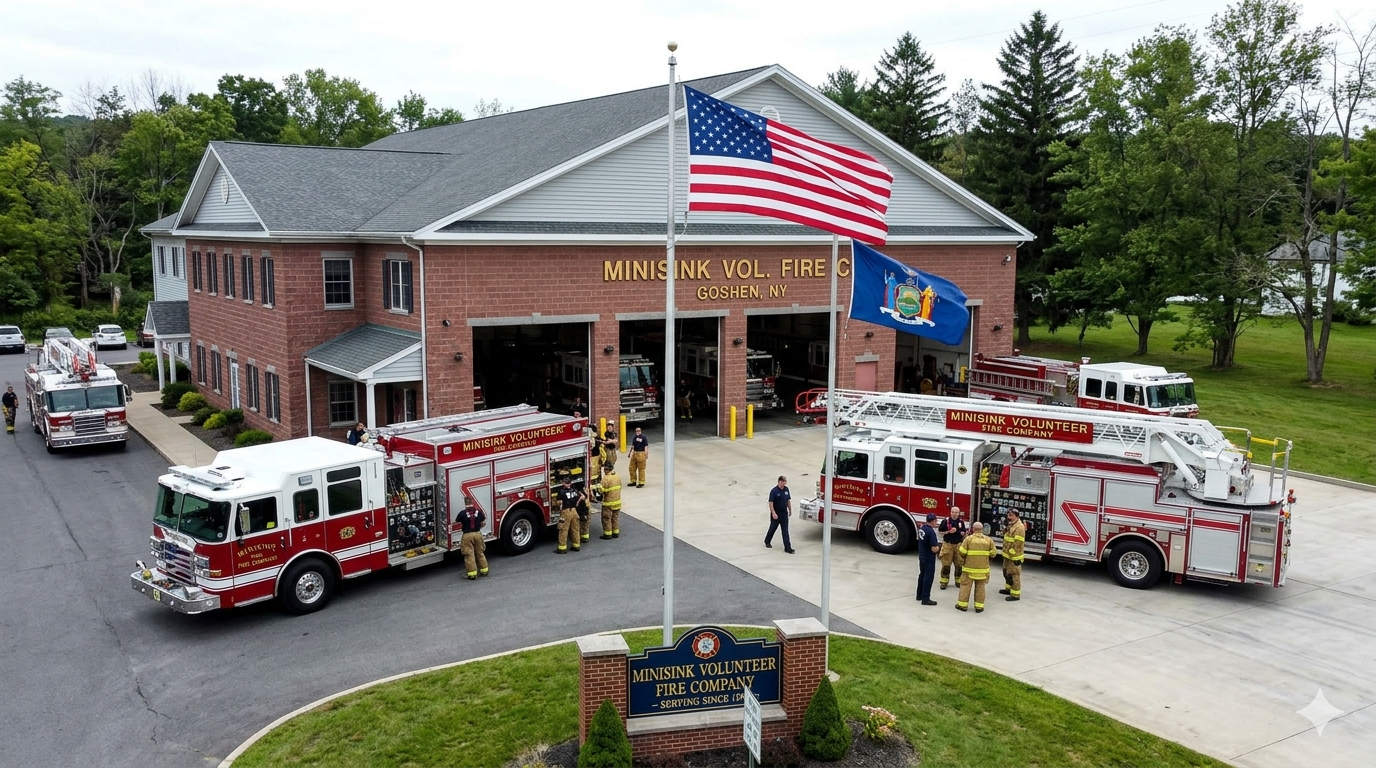
The main firehouse features a striking dual-level design. Combining a classic red-brick facade with modern, clean white siding and structural accents, the building perfectly mirrors the department itself—deeply rooted in tradition but outfitted for modern technical warfare against fires.
Multi-Bay Engine House
The facility boasts a spacious, multi-bay garage equipped with high-clearance overhead doors. This design allows for:
- Rapid Deployment: Fire trucks and rescue vehicles can pull out instantly without gridlock.
- Safe Maintenance: Ample indoor space allows engineers to perform routine checks, equipment staging, and mechanical upkeep protected from the harsh New York winters.
- Command Center Integration: Administrative offices, training rooms, and community spaces sit adjacent to the apparatus bays, creating a seamless operational workflow.
Fleet and Apparatus: The Tools of the Trade
When disaster strikes, bravery alone isn’t enough. Firefighters require sophisticated, heavy-duty machinery to suppress flames, extricate victims from vehicle accidents, and manage hazardous materials. The Minisink Volunteer Fire Company maintains a diverse fleet tailored for both structural urban fires and rural community responses.
| Vehicle Type | Primary Functions | Key Features |
|---|---|---|
| Tower / Ladder Trucks | Elevated rescue, high-angle master streams, roof ventilation. | Heavy-duty extendable ladders, integrated water ways, rescue baskets. |
| Class-A Pumpers (Engines) | Frontline fire attack, hose deployment, water supply routing. | High-capacity water tanks, sophisticated foam systems, side-mount pump panels. |
| Rescue & Support Units | Traffic control, scene lighting, specialized extraction tools (Jaws of Life). | Extended cab space for personnel, high-output generator lighting. |
The department’s apparatus prominently feature the iconic red and white high-visibility livery, ensuring safety while navigating busy Goshen roadways. Each truck is meticulously organized, holding hundreds of feet of attack lines, supply hoses, medical kits, and breathing apparatus (SCBA).
The Lifeblood: The Volunteer Firefighters
The impressive brick station and the shiny red trucks mean nothing without the dedicated personnel who operate them. The roster of the Minisink Volunteer Fire Company is a cross-section of the community itself. Among the ranks, you will find local business owners, mechanics, teachers, office workers, and students.
Rigorous Training and Standards
A common misconception is that “volunteer” means “amateur.” In New York State, volunteer firefighters are held to incredibly strict training standards comparable to career departments. Before ever stepping foot inside a burning building, a Minisink volunteer must complete hundreds of hours of foundational training, including:
- Firefighter I & II Certification: Learning the physics of fire, ventilation tactics, and search-and-rescue techniques.
- Hazardous Materials Mitigation: Identifying and containing chemical leaks or dangerous spills.
- Emergency Medical First Responder (EMR/EMT): Providing crucial, life-saving stabilization before an ambulance arrives.
- Live Fire Drills: Regular, ongoing training simulations to keep skills sharp under intense heat and stress.
The Brotherhood and Sisterhood on the Asphalt
Operational safety relies heavily on teamwork. Whether conducting a routine equipment check in the firehouse driveway or managing a complex scene, the camaraderie among the members is palpable. Constant communication, mutual trust, and a shared mission keep these individuals safe when facing chaotic situations.
Beyond Firefighting: A Community Cornerstone
The Minisink Volunteer Fire Company’s impact extends far beyond extinguishing structural fires. They serve as educators, safety advocates, and cultural pillars within Goshen and its surrounding towns.
Fire Prevention and Public Outreach
The best fire is the one that never starts. The company invests heavily in public safety campaigns, particularly targeting local schools. During Fire Prevention Week, volunteers bring the apparatus to children, teaching them:
- “Stop, Drop, and Roll” protocols.
- The importance of home escape plans.
- How to test and maintain residential smoke and carbon monoxide detectors.
Mutual Aid Agreements
Disaster does not respect town borders. The Minisink Volunteer Fire Company participates in a robust county-wide mutual aid system. When a massive multi-alarm fire or natural disaster strikes a neighboring district in Orange County, Minisink’s crews and trucks deploy to assist, ensuring that the entire region remains protected through a unified network of volunteer forces.
Why Volunteer Fire Companies Matter Economically
From an economic perspective, volunteer fire companies provide an invaluable service to taxpayers. If municipalities like Goshen had to transition entirely to a fully career, paid fire department, local property taxes would rise exponentially to cover salaries, benefits, pensions, and 24/7 station staffing.
Taxpayer Value: The volunteer model saves local communities millions of dollars annually. Every hour a Minisink volunteer spends training, maintaining trucks, or responding to calls is an hour given entirely free out of love for the community.
Furthermore, having a well-equipped, highly-trained fire company right in the neighborhood helps keep home insurance premiums lower for local residents, as insurance algorithms heavily favor properties located within a short response radius of active fire stations.
How to Support the Minisink Volunteer Fire Company
As a volunteer organization, community backing is essential to keep the department operational. There are several ways residents and business owners can show their support:
1. Join the Ranks (Active Membership)
The department is always looking for new members. If you have the physical stamina, mental fortitude, and a desire to give back, you can apply to become an active firefighter. No prior experience is necessary; the department provides all the necessary gear, equipment, and training.
2. Support Support Roles
Not everyone wants to run into a burning building, and that is okay! The company requires strong administrative support, help with fundraising events, auxiliary support, building maintenance, and community outreach coordinators.
3. Financial Donations
While some funding comes from local tax districts, a significant portion of specialized rescue tools, community events, and member morale programs are funded via direct donations from grateful citizens.
Conclusion: Serving Since Day One
Standing proudly under the American and New York State flags, the Minisink Volunteer Fire Company embodies the very best of local civic pride. Their prominent brick station stands not just as an emergency dispatch hub, but as a monument to community unity, courage, and vigilance.
The next time you see the red and white trucks rushing down the street, or spot the volunteers drilling on a quiet evening, remember the immense sacrifice these individuals make. They are the true guardians of the neighborhood—serving since day one, always ready to answer the call.