
Jewish weddings are globally renowned for their unmatched energy, deep-rooted traditions, and emotional depth. Among all the rituals, none captures the pure essence of celebration quite like the traditional dance at a Jewish wedding. It is not just entertainment; it is a spiritual commandment (Mitzvah) to bring joy to the newlywed couple.
From the iconic lifting of chairs to the spirited concentric circles, Jewish wedding dances are a beautiful blend of history, community, and unbridled happiness.
Whether you are planning your own wedding, attending as a guest, or simply curious about cultural traditions, this comprehensive guide explores everything you need to know about traditional Jewish wedding dances.
1. The Core Philosophy: The Mitzvah of Simchat Chatan v’Kallah
Before diving into the specific dances, it is essential to understand why dancing is so central to a Jewish wedding.
In Jewish tradition, entertaining and bringing joy to the groom (Chatan) and bride (Kallah) on their wedding day is considered a Mitzvah (a divine commandment/good deed). The Talmud teaches that the entire community must come together to make the couple happy. Therefore, when guests dance at a Jewish wedding, they aren’t just partying—they are fulfilling a sacred and beautiful religious duty.
2. The Hora: The Heartbeat of Jewish Wedding Dancing
When people think of a traditional dance at a Jewish wedding, The Hora is almost always the first thing that comes to mind.
How the Hora is Danced
The Hora is a high-energy circle dance that usually takes place early in the reception, often immediately after the grand entrance of the bride and groom.
- The Circles: Guests hold hands or link shoulders, forming one or more large, concentric circles around the newlyweds.
- The Footwork: The basic step is a grapevine-style movement, moving counter-clockwise. The circle speeds up as the music accelerates.
- The Atmosphere: The energy is electric, characterized by clapping, cheering, and singing traditional songs like “Hava Nagila” or “Siman Tov u’Mazel Tov”.
Lifting the Chairs (The Ultimate Highlight)
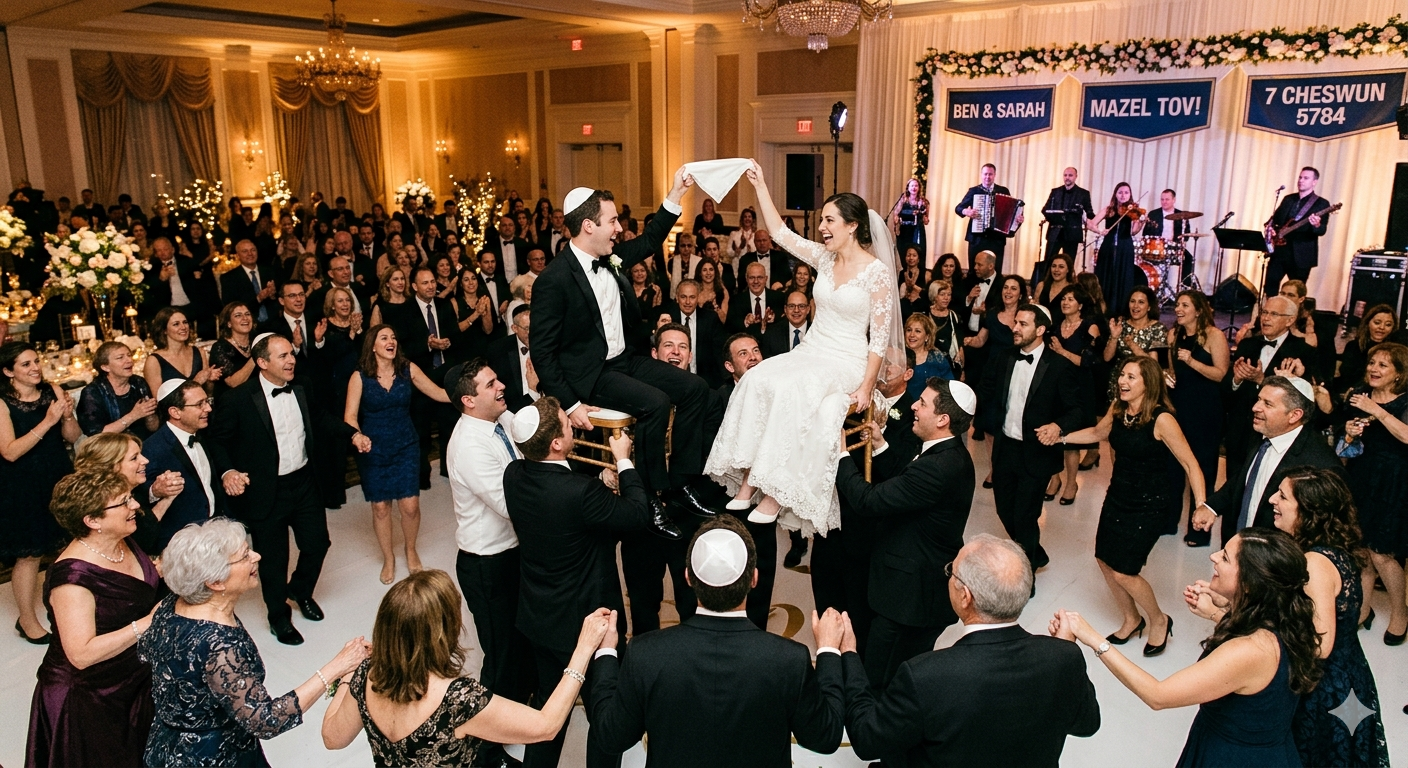
As seen in traditional celebrations (and beautifully captured in images like watermarked_img_792493822652774709.png), the absolute climax of the Hora occurs when strong guests lift the bride and groom high into the air on chairs.
- The Connection: While airborne, the bride and groom hold onto opposite ends of a single handkerchief or napkin, symbolizing their connection even as they are lifted individually.
- The Parents: In many modern celebrations, the parents of the bride and groom are also lifted on chairs to honor their role in raising the couple.
3. The Mezinke (Krenzl): Honoring the Parents
The Mezinke (also known as Krenzl, meaning crown) is a touching and emotional dance dedicated exclusively to parents who have just married off their last child. It signifies the completion of a major parenting milestone.
The Ritual
- The parents sit on chairs in the center of the dance floor.
- The bride and groom place a crown of fresh flowers (Krenzl) on their parents’ heads.
- All the wedding guests form a circle around the parents, dancing, kissing, and congratulating them as they pass by.
4. The Gladdening of the Bride (Mezinke and Schtick)
Another beautiful custom, particularly rooted in Orthodox and traditional communities, is Schtick (or Kallah Gladdening).
During this segment of the night, the bride sits in the center of the floor, and guests take turns performing silly, creative, and entertaining acts in front of her to make her laugh.
- Guests might juggle, wear funny costumes, perform acrobatics, or hold up handmade signs with inside jokes.
- Large arches made of ribbons or balloons are often danced over the bride’s head.
This tradition emphasizes that the wedding is entirely about making the couple smile and feel loved.
5. Mechitzah Dancing: Traditions in Orthodox Weddings
In Orthodox Jewish weddings, the dancing follows strict laws of modesty (Tzniut).
- The Divider (Mechitzah): The dance floor is physically divided by a curtain or partition called a Mechitzah.
- Separated Dancing: Men dance with men on one side, and women dance with women on the other side.
- The Energy: Despite the separation, the energy on both sides is incredibly high. Men often perform intense, athletic leaps, kicks, and line dances, while the women’s side features intricate circle dances and joyful singing around the bride.
6. Popular Songs for Traditional Jewish Wedding Dances
A Jewish wedding dance floor is nothing without its iconic music. If you are hiring a live band or a DJ, these are the essential tracks that keep the traditional energy alive:
| Song Name | Mood / Purpose | Significance |
|---|---|---|
| Hava Nagila | High Energy / Fast-paced | The universal anthem for the Hora and chair-lifting. |
| Siman Tov u’Mazel Tov | Celebratory / Joyous | Means “A good sign and good luck.” Sung during congratulations. |
| Od Yishama | Spiritual / Uplifting | Lyrics from Jeremiah, celebrating the sounds of joy in Jerusalem. |
| Mashiach | Energetic / Fast | Often played during intense circle dancing on the men’s side. |
7. Guest Etiquette: How to Participate in a Jewish Wedding Dance
If you are attending a Jewish wedding for the first time, the dance floor can look intimidatingly fast and chaotic. Don’t worry! Here are a few simple tips to help you blend in and fulfill the Mitzvah of making the couple happy:
- Jump Right In: You don’t need to know complicated steps. For the Hora, just hold hands, follow the direction of the circle, and move your feet.
- Keep the Circle Strong: If people are rushing into the center, hold tight to the hands of the people next to you to maintain the circle’s structure.
- Respect the Vibe: If it is an Orthodox wedding, make sure you stay on your respective side of the Mechitzah.
- Help with the Chairs: If you are physically able and asked to help lift a chair, step up! It takes a team of strong, steady hands to keep the bride and groom safe and flying high.
Conclusion: A Celebration of Community and Love
The traditional dance at a Jewish wedding is far more than just a routine; it is a physical manifestation of love, community support, and spiritual joy. From the dizzying heights of the Hora chairs to the emotional tears of the Mezinke, these dances bind generations together, ensuring that the couple starts their new life surrounded by absolute happiness.
If you are planning your wedding, embracing these rich traditions will guarantee an unforgettable night filled with energy, culture, and memories that will last a lifetime. Mazel Tov!
SEO Optimization Notes (For the User):
- Primary Keyword Used:
traditional dance at jewish wedding - Secondary Keywords:
The Hora,Jewish wedding chair lifting,Mezinke dance,Mitzvah wedding dancing,Hava Nagila wedding dance. - Structure: Optimized with clear H2 and H3 headings, bold text for scannability, and a structured table for readability.