

Imagine a tech-focused logistics firm based in Dubai CommerCity. On paper, the last twelve months have been a triumph. Revenue is up by 40%, the team has doubled in size, and they’ve just moved into a larger warehouse to accommodate the surge in e-commerce demand. Yet, if you sit down with the founder, the story is different. Behind the gleaming KPIs, the operation is fraying at the edges. Cash flow is a constant source of anxiety despite the sales growth, the founder is still personally approving every petty cash voucher, and the “culture” that made the startup great has been replaced by a quiet, mounting confusion.
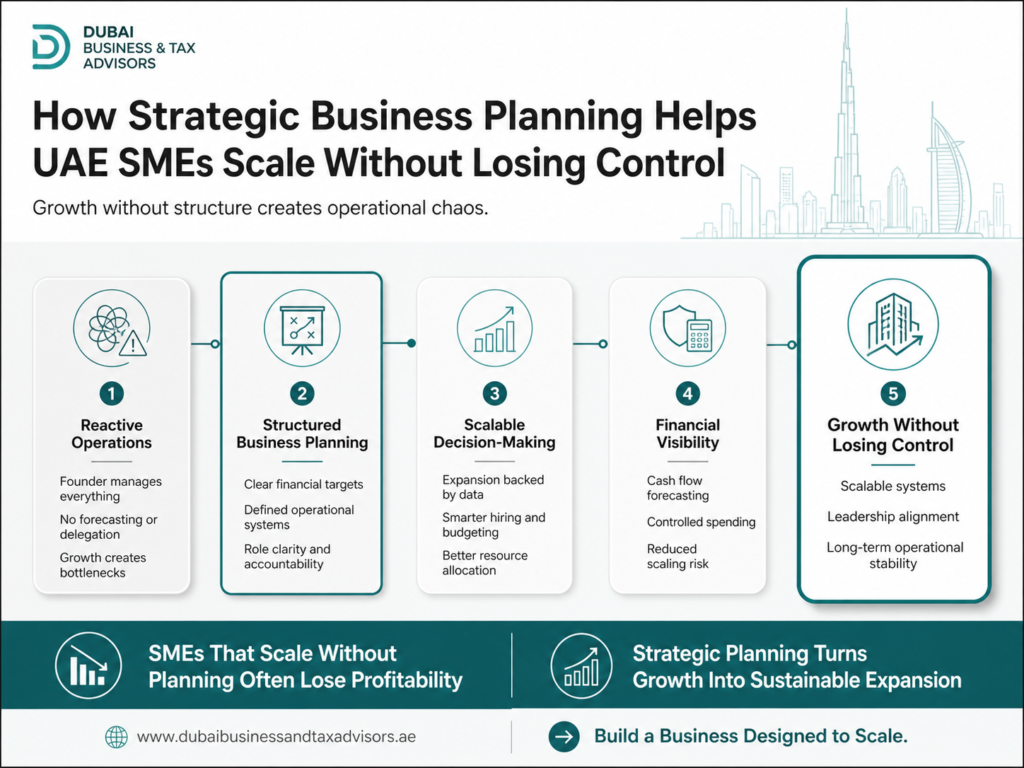
Growth, as it turns out, isn’t the problem. The problem is the loss of control that usually hitches a ride with rapid scaling. Many SMEs in the UAE find themselves in this exact “growth trap.” They have the momentum, but they lack the structural brakes and steering needed to handle the speed. You start out as a nimble team where everyone knows their role, but suddenly, you wake up managing a complex organization where revenue increases, but your clarity on where that money is going and why the engine is smoking declines. This is precisely where professional business plan consulting services shift from being a “nice-to-have” administrative exercise to the strategic anchor that keeps a business from drifting into chaos.
What Losing Control Actually Looks Like?
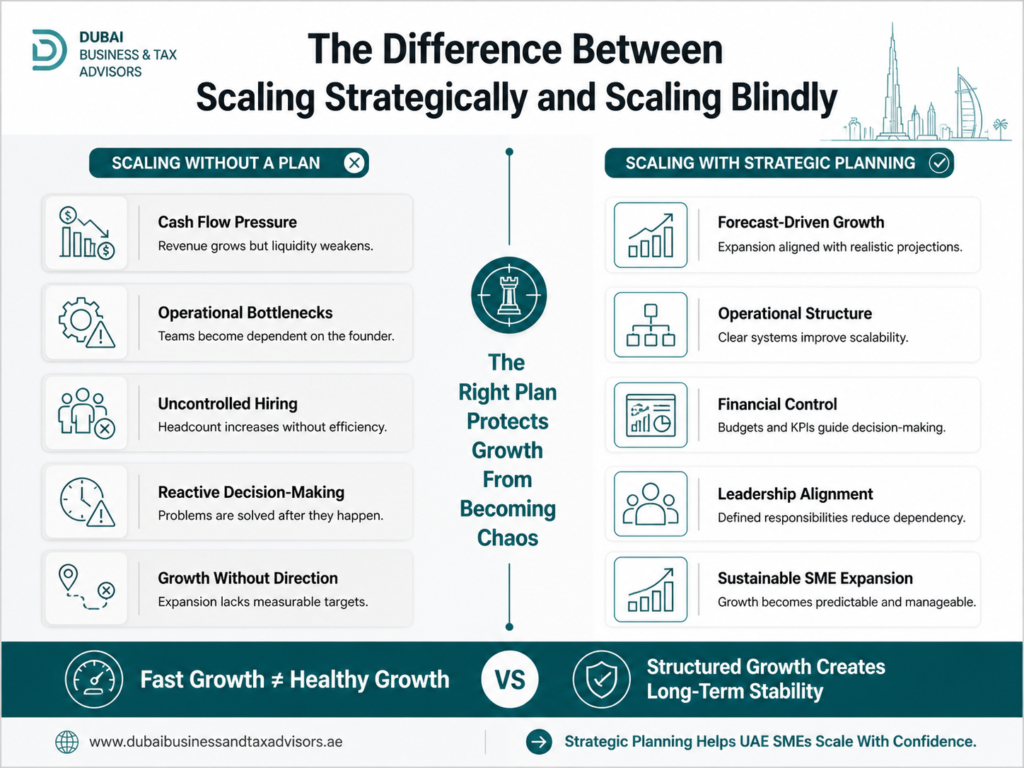
We often talk about scaling in purely positive terms, but for the person in the driver’s seat, it can feel like the wheels are about to come off. This loss of control usually manifests in four distinct, painful ways.
Financial Blind Spots
The most dangerous transition an SME makes is moving from “managing by bank balance” to “managing by forecast.” When you’re small, you can see every dirham. When you scale, profit and cash flow often start moving in opposite directions. You might be profitable on an accrual basis, but your cash is tied up in inventory, receivables, or security deposits. Without real-time visibility, you’re flying a plane through a storm with a broken altimeter.
Operational Chaos
Processes that worked for five people inevitably break when you have fifty. Suddenly, work becomes reactive. Instead of following a documented workflow, the team spends their day “firefighting” dealing with the same avoidable mistakes over and over. Does the founder still need to be involved in every single decision? If the answer is yes, you haven’t scaled; you’ve just made your own life more difficult.
Team Misalignment
As you hire faster, the “invisible” communication that happens in a small office disappears. Roles become blurry. Accountability drops. You might notice that execution slows down because people are waiting for instructions rather than owning their outcomes. Growth doesn’t just add people; it adds layers of potential misunderstanding.
Decision Fatigue
When everything is growing at once, every opportunity feels like a priority. Should you open that second branch in Abu Dhabi? Should you pivot to a SaaS model? Without a strategic framework to filter these choices, the sheer volume of decisions becomes overwhelming. You end up choosing the “loudest” option rather than the most strategic one.
Why UAE SMEs Struggle More During Scaling?
Scaling in the UAE comes with a specific set of localized pressures that you won’t find in London or New York. The environment is high-speed and high-reward, but the regulatory landscape has matured significantly over the last few years.
The introduction of Corporate Tax and the rigorous enforcement of VAT mean that “messy books” are no longer just an internal problem,they are a legal liability. A lack of clarity on compliance can lead to penalties that wipe out a year’s worth of growth. Furthermore, banking in the region remains a hurdle for many. Strict KYC (Know Your Customer) requirements and a conservative lending environment mean that if your financial planning isn’t pristine, accessing the working capital you need to sustain growth becomes an uphill battle.
Then there is the structural complexity of Free Zones versus the Mainland. Decisions made during the startup phase regarding your license or jurisdiction might not serve you once you reach a certain scale. Restructuring a business mid-growth is expensive and distracting, yet many SMEs find themselves forced to do so because their initial “plan” didn’t account for a ten-fold increase in headcount.
The Root Cause: Growth Without Strategic Direction
If we’re honest, most SMEs operate reactively. They respond to a customer’s request, a competitor’s move, or a sudden dip in sales. This “survival mode” is fine for the first year, but it’s a recipe for disaster during a scale-up.
The root cause of most chaotic growth is a lack of documented strategy. If your goals aren’t measurable and your financial planning isn’t aligned with your operations, you’re effectively building a house without a blueprint. Short-term decisions like taking on a high-maintenance client just for the revenue often override long-term sustainability. Without a strategic plan, you aren’t growing a business; you’re just getting bigger.
What Strategic Business Planning Really Does?
Forget the 50-page PDF that sits in a drawer gathering dust. Real strategic planning is about creating a living, breathing system for your business.
- It Brings Structure to Growth: It defines exactly what you are going to do and, more importantly, what you are not going to do. It sets the “North Star” so that when an opportunity comes along, you can ask: “Does this align with our three-year roadmap?”
- It Converts Guesswork into Data: Instead of saying “I think we’re doing well,” you have financial models, rolling forecasts, and KPIs. You can see a liquidity crunch coming three months away and adjust your spending accordingly.
- It Builds Founder-Independent Systems: The goal of scaling is to make the founder redundant in the day-to-day. Strategic planning creates the SOPs (Standard Operating Procedures) and delegation frameworks that allow the business to run itself.
- It Aligns the Team: When everyone knows the target, they don’t need to be micro-managed. Strategy provides the context for their work, which naturally increases accountability.
Why Do Most Plans Fail?(The Execution Gap)
We’ve all seen it: a company spends thousands on a strategy session, everyone leaves feeling inspired, and then nothing changes. Two weeks later, everyone is back to their old habits. This is the execution gap.
Most business plans fail because they are treated as a document rather than a system. There is no ongoing advisory, no refinement, and no tracking. A strategy that doesn’t include an implementation roadmap isn’t a strategy, it’s a wish list. In the UAE’s volatile market, a plan that isn’t iterated upon every quarter becomes obsolete almost as soon as it’s printed.
Scaling Without Losing Control.(A Practical Framework)
If you want to scale sustainably, you need to build four specific systems into the foundation of your business.
Financial Control Systems
This isn’t just about accounting; it’s about forward-looking finance. You need monthly cash flow forecasting that accounts for seasonal dips and payment delays. You need scenario planning: “What happens to our margins if the cost of raw materials increases by 15%?”
Operational Systems
This is where you document the “how.” Standard Operating Procedures ensure that the quality of your service doesn’t drop as you hire new people. Workflow optimization ensures that you aren’t adding headcount to solve a problem that could be fixed with better software.
Performance Tracking
If you can’t measure it, you can’t manage it. A real-time KPI dashboard allows leadership to see the health of the business at a glance. Are your customer acquisition costs rising? Is your employee turnover higher in one department than another? The data tells the truth when the “vibe” in the office is misleading.
Decision-Making Frameworks
You need a model for prioritization. Risk assessment systems should be in place so that before you commit to a major capital expenditure, you’ve analyzed the potential downside with the same enthusiasm you used for the upside.
Common Mistakes UAE SMEs Make While Scaling
The most common error is scaling revenue without strengthening the underlying systems. It’s like putting a Ferrari engine in a bicycle frame; the frame will snap.
Many founders hire too quickly without a clear structure, assuming that “more hands” will solve the chaos. In reality, more hands often just create more confusion if there isn’t a clear role for them. Others rely on generic business plan templates they found online. While these templates might help you get a bank account open, they are useless for actual scaling. A template doesn’t know your specific margins, your competitors in the DMCC, or your unique operational bottlenecks.
Finally, treating planning as a “one-time task” is a fatal mistake. Planning is a discipline, not an event.
When Strategic Support Becomes Essential?
There comes a point in every SME’s journey where “Doing It Yourself” stops being cost-effective. If you find that your growth feels more like a burden than an achievement, or if you realize you haven’t looked at your financial strategy in six months because you were too busy answering emails, you’ve reached that point.
Expert guidance isn’t just about someone telling you what to do; it’s about providing objective insight you can’t see from the inside. A professional view can translate a chaotic vision into a structured execution plan. When you engage with business plan consulting services, you aren’t just buying a document. You are buying the scalable systems and the financial clarity required to ensure that your 40% growth this year doesn’t lead to a 50% collapse next year.
From Planning to Execution: Turning Strategy into Results
The most successful businesses in the UAE treat strategy as a living process. They integrate their finance, operations, and leadership into a single feedback loop. They monitor their progress weekly, adjust their tactics monthly, and refine their strategy quarterly.
This integration is what allows a company to be both fast and stable. You can pivot quickly when the market changes because you know exactly how that pivot affects your cash flow and your team’s capacity. Strategy isn’t about being rigid; it’s about being prepared.
Addressing Common Misconceptions
There are several myths that keep SMEs from investing in strategic planning. The first is that “business plans are only for startups seeking funding.” On the contrary, a business plan is even more critical for an established SME that is about to scale.
The second myth is that “growth automatically means success.” In reality, many businesses grow themselves into bankruptcy by expanding too fast without enough capital or structure.
Another misconception is that “templates are enough.” As we’ve discussed, a template is a generic skeleton; it’s not the muscle and heart of your specific business. And finally, some believe that “consultants only create documents.” A high-quality consultant builds systems, implements tracking, and provides the advisory that turns a strategy into a reality.
Frequently Asked Questions
What is strategic business planning and why does it matter for UAE SMEs?
Strategic business planning is the process of defining your business goals, mapping out how to achieve them, and putting financial and operational controls in place to stay on track. For UAE SMEs, it provides a clear roadmap that keeps every decision aligned with long-term growth objectives rather than short-term reactions. Without a strategic plan, scaling often leads to disorganised operations, cash flow problems, and loss of management control. It is the difference between growing your business and simply making it bigger.
How does strategic planning help UAE SMEs manage rapid growth without losing control?
Rapid growth without structure is one of the most common reasons SMEs in the UAE struggle hiring too fast, overspending, and losing visibility over finances are all symptoms of unplanned scaling. A strategic plan establishes clear KPIs, budget boundaries, and operational processes that keep growth manageable and measurable. It ensures that as your team and revenue expand, your systems and controls expand with them. This structured approach allows you to scale confidently without the chaos that derails so many growing businesses.
How does strategic business planning improve cash flow management for UAE SMEs?
Cash flow is the lifeline of any SME, and poor planning is the number one reason businesses run out of money despite strong revenue. A strategic plan includes detailed cash flow forecasts that help you anticipate funding gaps, seasonal dips, and major expenditure periods well in advance. This forward-looking approach means you are never caught off guard by a shortfall that could have been predicted and prevented. With proper planning, your cash position remains strong enough to fund growth without relying on emergency borrowing.
Can strategic planning help UAE SMEs attract investors and secure business funding?
Absolutely,investors and lenders in the UAE want to see evidence that your business is run with financial discipline and long-term vision before committing any capital. A well-structured strategic plan demonstrates exactly that, showing clear revenue projections, growth milestones, and a defined path to profitability. It signals to funding bodies that your management team is in control and that their investment is in safe, capable hands. Without this foundation, even the most promising business idea struggles to secure the funding it needs to scale.
How often should UAE SMEs revisit and update their strategic business plan?
A strategic business plan is not a one-time exercise.it should be reviewed and updated at least every six to twelve months to remain relevant and effective. Market conditions in the UAE shift quickly, and your plan must reflect new regulatory changes, competitive dynamics, and internal business developments. Regular reviews also allow you to assess whether your KPIs are being met and adjust your strategy before small issues become expensive problems. Treating your plan as a living document rather than a filed report is what separates businesses that sustain growth from those that stall.
Conclusion:
Controlled growth never happens by accident. It is the result of a deliberate, disciplined approach to business. Scaling without structure might work for a while, but eventually the lack of clarity will catch up with you.
Strategic planning gives you the confidence to take risks because you understand their impact, and the freedom to step back from the day-to-day because you trust the systems you have built. That is where Dubai Business & Tax Advisors come in. From financial forecasting and cash flow management to KPI setting, budget planning, and corporate tax compliance, their experienced team ensures every aspect of your business is built for sustainable, controlled growth.
If you want to scale without losing the very thing you worked so hard to build, stop reacting and start planning. Partner with Dubai Business & Tax Advisors today your future self and your bank balance will thank you for it.