

Esports has transitioned from casual arcade tournaments into a multi-billion-dollar global industry. Modern competitive gaming requires intense mechanical skill, flawless reflexes, and deep strategic execution. At the heart of every successful tactical esports team sits a crucial, often underappreciated mastermind: the IGL, or In-Game Leader.
Whether you are watching a high-stakes Valorant Champions tour, a Counter-Strike 2 (CS2) Major, or a fast-paced Apex Legends lobby, the IGL is the glue that holds a team together.
In this comprehensive guide, we will break down exactly what an IGL is, their core responsibilities, why they are indispensable, and how you can become an effective In-Game Leader for your own squad.
What Does IGL Mean?
In gaming and esports, IGL stands for In-Game Leader.
The IGL is the designated shot-caller during a match. Think of them as the quarterback in American football, the point guard in basketball, or the conductor of an orchestra. While every player on a team has a specific role to play—such as the “entry fragger” who opens up space or the “anchor” who holds down a defensive site—the IGL is responsible for the macro-strategy, real-time adaptations, and overall coordination of the team.
Core Responsibilities of an In-Game Leader
The role of an IGL goes far beyond just telling teammates where to go. It requires a massive mental capacity, high emotional intelligence, and unparalleled map awareness. An effective IGL manages several key areas before, during, and after a match:
1. Strategy and Strat-Calling (The “Macro” Game)
Before a round or match even begins, the IGL usually works alongside the team coach to develop a game plan. They study opponent VODs (video on demand) to identify weaknesses, patterns, and habits.
- Mid-Round Calling: The true test of an IGL happens on the fly. If a planned strategy fails because an opponent throws an unexpected utility setup, the IGL must instantly pivot, reading the mini-map and calling for a “re-take,” a “rotate,” or a slow default play.
2. Economy Management
In tactical shooters like CS2 and Valorant, managing the team’s economy (money or credits) is vital to winning. The IGL decides:
- When the team should Full Buy (purchase premium rifles and full armor).
- When to Eco / Save (spend minimal credits to save for the next round).
- When to Force Buy (gamble on lower-tier weapons when a round win is absolutely desperate).
An error in economic management can cost a team multiple rounds down the line.
3. Ultimate and Utility Coordination
In hero-based tactical shooters like Valorant or Battle Royales like Apex Legends, abilities and Ultimates dictate the flow of combat. The IGL acts as the resource manager, tracking which ultimates their team has available and predicting what the enemy team is holding. They coordinate combos (e.g., combining a flashbang with a movement ability) to maximize their team’s efficiency.
4. Morale and Mental Fortitude
Esports can be incredibly stressful. When a team loses several rounds in a row, tilt and frustration can quickly ruin their performance. A great IGL serves as an emotional anchor. They keep communication clean, prevent arguments, and remind the team to focus on the next round rather than dwelling on past mistakes.
The Two Main Styles of In-Game Leading
Not all IGLs lead the same way. Depending on the team’s roster and the game being played, In-Game Leaders generally fall into two distinct styles:
The Loose / Adaptive Leader
This style relies heavily on the individual skill and instinct of the teammates. The IGL provides a loose framework or “default” setup at the start of a round and allows players to make aggressive plays or hunt for opening eliminations. Once an advantage is found, the IGL steps in to call the final execution.
- Pros: Unpredictable, highly creative, and lets star players shine.
- Cons: Can fall apart against incredibly disciplined defensive teams if the individual plays fail.
The Strict / Structured Leader
This style treats the game like a chess match. The IGL dictates almost every movement, piece of utility, and timing. Every player knows exactly where to look, when to throw a smoke, and when to execute.
- Pros: Highly reliable, minimizes individual errors, and maximizes utility value.
- Cons: Can become predictable if the opponent figures out the system, and leaves less room for individual flair.
Why Being an IGL is the Hardest Role in Esports
It is a well-known phenomenon in esports that IGLs often do not have the highest “frag count” (elimination statistics) on the scoreboard.
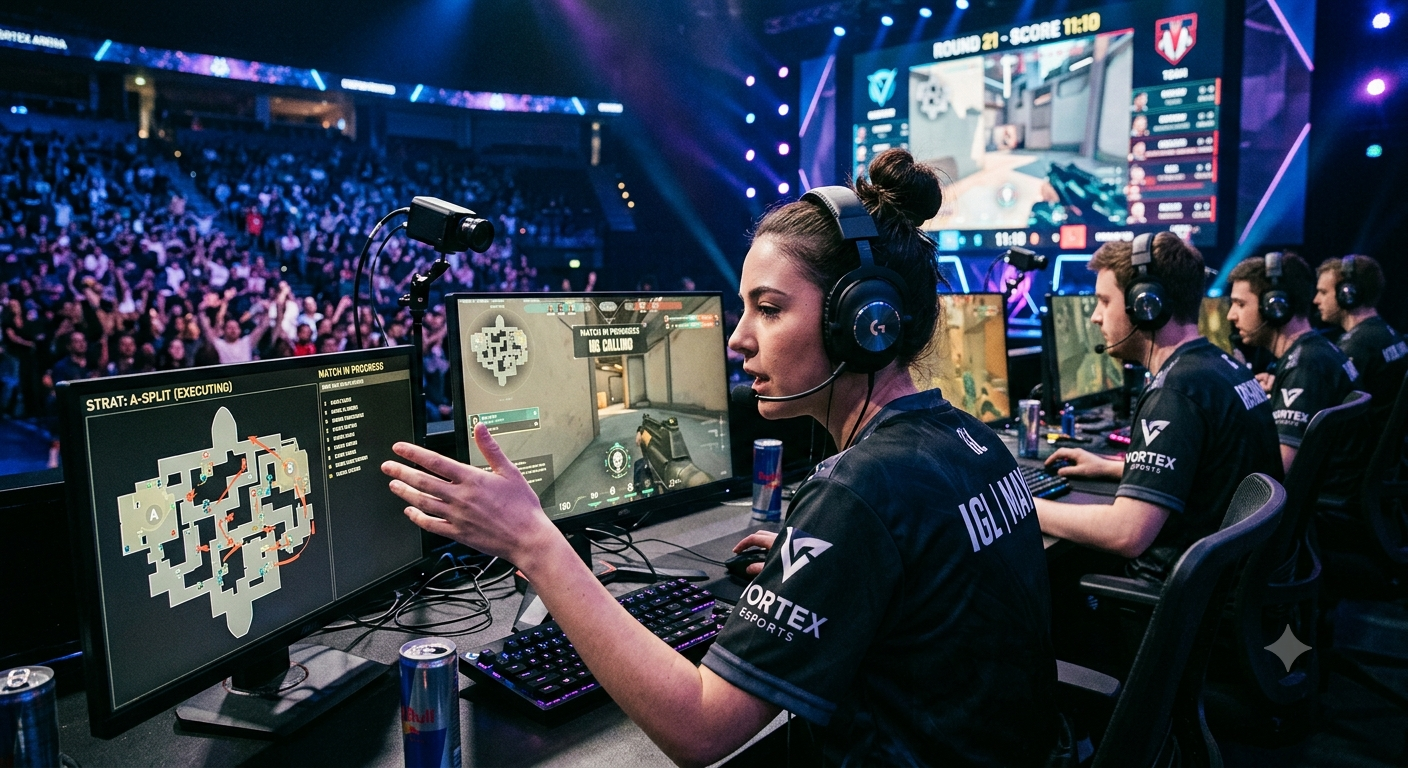
While viewers often focus purely on a player’s Aim or K/D (Kill/Death) ratio, the mental tax of being an IGL is immense. As shown in the image 9851582418497193324.jpeg, an IGL is constantly analyzing a secondary screen or tactical mini-map, assessing strategies while simultaneously executing their own physical mechanics in the game. An IGL has to play their own character, track 4 teammates, monitor 5 enemies, count utility, manage the clock, and call strategies all at the exact same time. Because of this split focus, an IGL’s individual mechanical performance can occasionally take a hit—but their value to the team’s win condition is immeasurable.
Famous Examples of Legendary IGLs
To truly understand the impact of an elite IGL, look at some of the most decorated leaders in esports history:
- Lukas “gla1ve” Rossander (Counter-Strike): Widely considered the greatest CS:GO IGL of all time, he led Astralis to four Major championships through an era of unprecedented tactical dominance and revolutionary utility usage.
- Finn “karrigan” Andersen (Counter-Strike): Known as the master of building international, superstar rosters. Karrigan is famous for his adaptive leading style, taking multiple different lineups to the absolute top of the world rankings.
- Matias “Saadhak” Delipetro (Valorant): The brain behind LOUD’s world championship run, celebrated for his incredible mid-round calling and ability to develop young, raw talent into world-class tactical players.
- Phillip “ImperialHal” Dosen (Apex Legends): Known as the “CEO of Apex,” Hal’s intense, aggressive, and highly decisive micro-management led TSM to multiple global championships in the chaotic environment of a Battle Royale.
How to Become a Better In-Game Leader
If you want to step up and become the IGL for your ranked stack or amateur team, focus on developing these essential habits:
1. Master Your Communication (Comms)
Clear, concise communication is the backbone of leadership. Eliminate frantic screaming or vague callouts like “He’s over there!” Instead, use precise language: “One enemy, long A, low health, holding with an Operator.” Keep the comms channel quiet when your teammates are trying to listen for footsteps.
2. Deepen Your Game Sense
To lead others, you must know the game inside and out. Spend time studying map layouts, common crosshair placements, wall-bang spots, and utility lineups. You should be able to visualize exactly what is happening on the other side of the map just by looking at your mini-map or reading the kill feed.
3. Record and Review Your Games (VOD Review)
You cannot fix mistakes if you do not see them. Watch recordings of your team’s matches. Look at the rounds you lost and analyze why they failed. Was it a breakdown in communication? Did you call the execute too late? Did you miscalculate the enemy’s economy? Use these insights to adjust your future playbooks.
4. Remain Calm Under Pressure
Your team will mimic your emotional state. If you panicking or sounding defeated, your teammates will lose confidence. Keep your tone level, encouraging, and highly decisive—even if a call you make turns out to be wrong, a unified team executing a bad plan together often fares better than a fractured team hesitating over two different plans.
Summary: The Unsung Heroes of Gaming
The acronym IGL (In-Game Leader) represents the intellectual backbone of competitive gaming teams. While they might not always get the flashy highlight reels or top the MVP voting, their strategic vision, real-time problem solving, and leadership are what ultimately lift trophies.
The next time you watch a professional esports match, try to look past the crisp headshots and pay attention to how a team rotates, saves their economy, or perfectly counters an opponent’s push. That is the invisible hand of the IGL at work.