

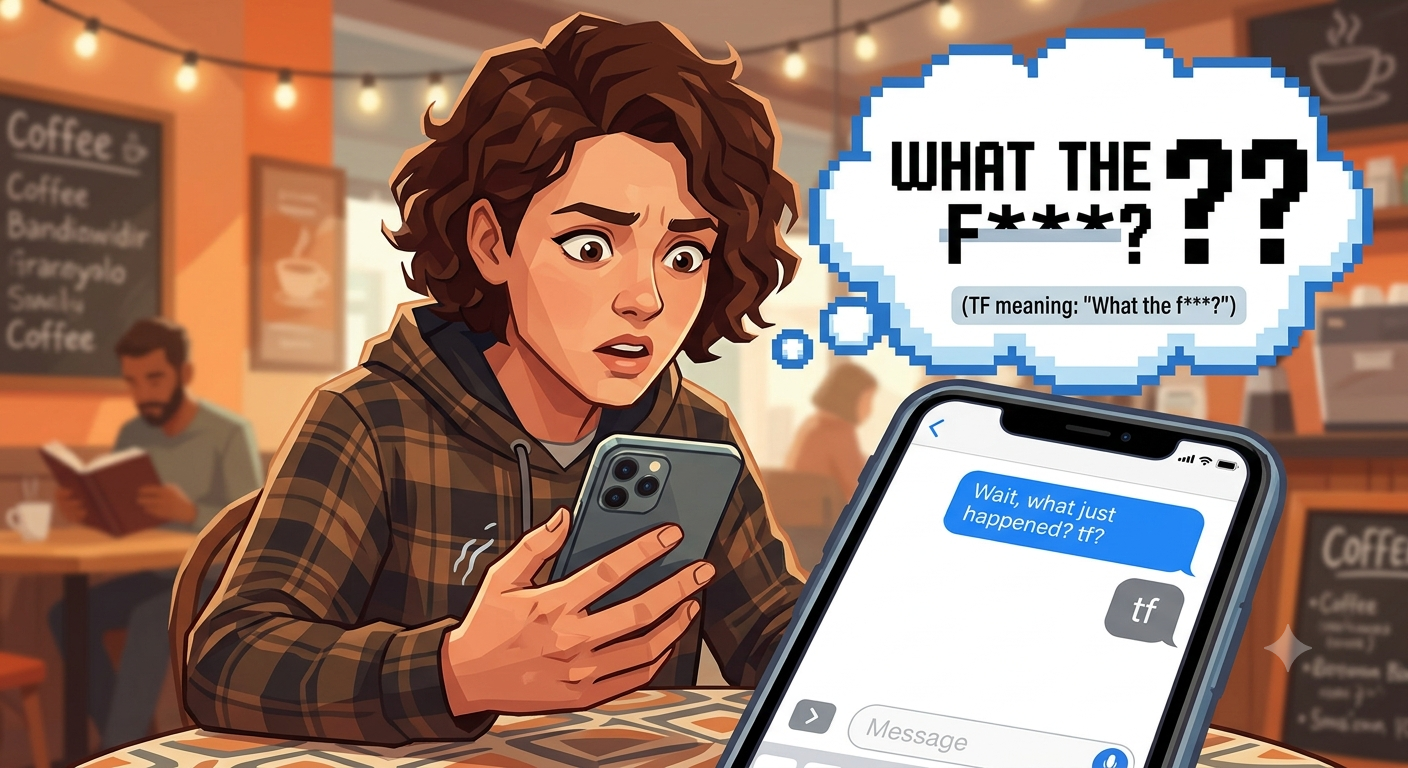
In the fast-paced world of digital communication, internet slang and acronyms have become the universal language of social media, gaming, and instant messaging. If you have been scrolling through TikTok, Instagram, Twitter (X), or chatting with friends on WhatsApp and Discord, you have likely encountered the two-letter acronym “TF.”
But what does TF mean in chat? Why is it so popular, and how should you use it without causing a misunderstanding?
This comprehensive guide breaks down everything you need to know about the TF meaning in text, its origins, variations, daily use cases, and professional boundaries.
1. What Does TF Mean in Chat? The Primary Definition
In 95% of online conversations, TF stands for “The F*”. It is a condensed, text-friendly version of a popular English expletive used primarily as an intensifier.
Instead of adding literal meaning to a sentence, TF is used to amplify the emotional weight behind a statement—usually expressing deep shock, confusion, frustration, or disbelief.
The Structural Evolution of TF
To understand TF, it helps to look at its closely related cousin, WTF (What The F***). While WTF asks a complete question (“What is happening?”), TF is highly versatile and acts as an emotional modifier that can slide into almost any part of a sentence.
- Standard English: “Why did you do that?”
- Slang Text Version: “Why TF did you do that?”
2. The Origins and History of TF Slang
While it feels like Gen Z or millennial internet culture invented this slang, the roots of the phrase actually go back much further.
According to linguistic records, the spoken phrase “the f***” emerged as early as the 1910s as a harsher alternative to older expressions like “the hell” or “the heck”.
However, its transformation into the acronym TF began in the mid-to-late 1980s, mirroring the rapid rise of internet relay chats (IRC) and early texting. Because character limits were tight on early mobile phones and typing out full curse words was tedious, users truncated the phrase to “TF”. By the 2000s, it became a standard fixture in global internet texting culture.
3. How TF is Used in Daily Conversations (With Examples)
The beauty (and complexity) of TF lies in its emotional flexibility. It changes meaning based entirely on context and punctuation. Here are the five most common ways TF is used in chat:
A. Expressing Shock or Absolute Disbelief
When something completely unexpected happens, dropping a simple “TF” or adding it to a question highlights your bewilderment.
- Example: “TF just happened in the movie finale?!”
- Context: You are stunned by a massive plot twist.
B. Conveying Frustration or Annoyance
If someone or something is irritating you, TF acts as an outlet for that negative energy.
- Example: “Why TF is my internet connection so slow today?”
- Context: You are working on an important task and the Wi-Fi drops.
C. Pure Confusion
When a situation makes absolutely no logical sense, TF signals that you need urgent clarification.
- Example: “Who TF texted me at 3:00 AM?”
- Context: You wake up to a random, unrecognized phone number on your screen.
D. Sarcasm and Comedic Relief
In casual friendships, TF can be used playfully to mock a ridiculous statement or situation.
- Example: “You think pineapple belongs on pizza? TF is wrong with you 😂”
- Context: Lighthearted banter between friends.
4. Categorized Examples of TF in Text Slang
To help you seamlessly navigate online spaces, here is a breakdown of how TF alters the tone of regular questions:
| Normal Text Question | Slang Version with “TF” | Emotional Tone Conveyed |
| “What are you doing?” | “What tf are you doing?” | Disbelief / Distrust |
| “Where are you?” | “Where tf are you?” | High Urgency / Annoyance |
| “How did you win?” | “How tf did you win?!” | Shock / Amazement |
| “Who said that?” | “Who tf said that?” | Aggression / Anger |
5. Alternative Meanings of TF (Context Matters!)
While “The F***” is the dominant definition online, acronyms can be highly contextual. Depending on the platform, community, or niche you are interacting with, TF can stand for entirely different concepts.
1. In Gaming: Team Fortress
If you are chatting on Discord, Steam, or Reddit gaming forums, TF often refers to Team Fortress (specifically TF2), the legendary multiplayer first-person shooter game developed by Valve.
2. In Relationships: True Friend
In wholesome, sentimental social media posts or captions, younger audiences occasionally use TF as an abbreviation for True Friend.
- Example: “Shoutout to Sarah, a real TF 💖”
3. In Tech & Hardware: TF Card (TransFlash)
If you are looking at smartphone specs or camera gear, a TF Card stands for TransFlash Card. This was the original name for what we now universally call a MicroSD card.
4. On Twitch: Troll Face (Emoji Code)
Older Twitch stream viewers use :tf: as a text command to generate the infamous “Troll Face” meme icon in chat boxes.
5. In Niche Communities: Transformation
In digital art, anime, and online fantasy communities, TF can stand for Transformation (characters shifting shapes or forms).
6. Texting Etiquette: When to Use (and Avoid) TF
Because TF contains a hidden profanity, masking it with an acronym does not completely strip away its aggressive or informal nature. Understanding boundaries is crucial.
✅ When it is Safe to Use:
- With Close Friends: If your peer group uses casual profanity safely, TF is perfectly fine.
- Public Social Media Content: Commenting under memes, viral videos, or reacting to pop-culture news on public threads.
- Gaming Lobbies: High-stress gaming moments where fast, expressive typing is needed.
❌ When to Absolutely Avoid It:
- Workplace Communication: Never use TF on Slack, Microsoft Teams, or work emails. It looks highly unprofessional and can be flagged by HR.
- Talking to Elders/Parents: Unless your parents are exceptionally tuned into internet culture, it can come across as highly disrespectful.
- Customer Support: When messaging a business page for a refund or assistance, using TF can make you sound hostile, reducing the chances of getting polite help.
7. Synonyms and Related Internet Acronyms
If you want to vary your digital vocabulary or find softer, safer alternatives to TF, consider these common abbreviations:
- WTF: What The F*** (The classic, all-inclusive reaction to weird things).
- WTH / STH: What The Hell / Who The Hell (A slightly toned-down version that is less offensive).
- STG: Swear To God (Used to emphasize that you are telling the absolute truth).
- FR: For Real (Used to ask for confirmation or agree completely with someone).
- SMH: Shaking My Head (Conveys disappointment or disapproval without anger).
Conclusion: Mastering Modern Text Slang
Internet abbreviations like TF are designed to save time while injecting raw, human emotion into lifeless text screens. Ultimately, TF means “the f*”—a highly potent conversational tool that perfectly mirrors surprise, confusion, or anger.
By paying attention to the context of your chat, who you are talking to, and keeping alternative meanings in mind, you can effortlessly decode and participate in modern digital conversations without missing a beat.
Frequently Asked Questions (FAQs)
Q1: Is TF a bad word?
Yes, fundamentally it represents a swear word. While it is abbreviated to bypass strict profanity filters, its intent is still vulgar, so it should be used with caution.
Q2: What does TF mean from a girl or guy in a flirty way?
TF itself isn’t inherently flirty. However, if someone says something like “Why tf are you so cute?”, they are using TF as an extreme intensifier to playfully compliment you.
Q3: How do you pronounce TF when reading it?
Most people do not say “T-F” out loud. When reading a text message silently, your brain automatically fills it in as the full phrase “the f“.*